Abstract
This study tests whether the centers of some black holes could be ordinary neutron stars. The answer depends on what “contain” means. A long-lived, pressure-supported neutron star at the center of an established black hole is not supported by standard general relativity and ordinary stellar matter. Neutron-rich matter can, however, occur inside a black-hole event horizon during collapse or capture. That weaker statement is physically reasonable and does not require a permanent neutron-star core.
Four calculations separate these possibilities. A 1.4-solar-mass star of radius 12 km has a Schwarzschild radius of 4.135 km and compactness 0.345, so it is not itself a black hole. The Buchdahl inequality requires a regular, static, spherical, isotropic star with outward-nonincreasing density to remain outside 1.125 times its Schwarzschild radius. In a uniform-density diagnostic model, central pressure diverges at that limit before the stellar surface can reach its own horizon. A captured 12 km neutron star encountering a million-solar-mass black hole has a nominal tidal radius only 0.000363 times the horizon radius, illustrating why horizon crossing need not instantly destroy neutron-star matter.
These results reject the stable ordinary-core version within the stated model and support a narrower transient-interior hypothesis. They do not identify the ultimate composition of black-hole interiors, establish a universal lifetime for neutron matter, or rule out every exotic or quantum-gravity model. A successful permanent-core proposal would need to evade at least one assumption of these tests and supply a globally consistent spacetime, a stability calculation, and an observational prediction.
Study status
Theoretical feasibility study and AI-assisted literature synthesis. The calculations reproduce elementary consequences of established models. This is not a peer-reviewed paper, a numerical-relativity simulation, or a report of new experimental evidence.
1 The hypothesis and what would count as support
The motivating idea is sensible to test: neutron stars resist gravity at nuclear densities, so perhaps similar matter survives at the center of a black hole. The difficulty is that high density alone does not define a neutron star, and a black hole is defined by causal structure rather than by a particular material. A neutron star is a self-gravitating object whose pressure and gravity are approximately balanced. Neutron-rich matter falling through a horizon need not remain such an object.
Two distinct hypotheses
Stable core hypothesis. An astrophysical black hole contains an ordinary neutron star that remains a central, approximately hydrostatic object for a long time compared with its dynamical time. This is the strong interpretation tested here. “Ordinary” means matter described by a conventional neutron-star equation of state, without an exotic negative-pressure core or modified gravity.
Transient interior hypothesis. During formation or capture, an event horizon can enclose matter that is still neutron rich, or a recognizable neutron-star configuration for part of a dynamical evolution. This hypothesis does not assert equilibrium at the center, indefinite survival, or an observable surface inside the horizon.
Definitions that prevent misleading comparisons
An event horizon is the boundary beyond which a future-directed signal cannot reach distant future observers. It is a global property of the entire spacetime. A future-trapped sphere satisfies a geometric condition: both inward- and outward-directed future light rays normal to the sphere initially move toward smaller area. In a stationary Schwarzschild black hole these notions align at the horizon, but during formation an event horizon can enclose regions that are not yet locally trapped.
The areal radius r is defined by the area of a spherical surface, A = 4πr². It need not equal a ruler-measured radial distance. Uppercase R denotes a star’s surface radius; M denotes its total gravitational mass. For a smaller captured star inside a much larger system, its own mass is written m★ and the black-hole mass is MBH. These are not interchangeable.
Scope and method
The equilibrium test assumes general relativity, spherical symmetry, no rotation, isotropic pressure, a regular center, nonnegative density and pressure, and a density that does not increase outward. These assumptions make the test transparent, not universal. Real neutron stars rotate and contain uncertain high-density phases. The study therefore uses exact idealized constraints, explicit numerical examples, and primary literature rather than claiming a fully realistic stellar evolution calculation.
Support for the strong hypothesis would require an actual equilibrium solution embedded consistently in a black-hole spacetime, plus evidence that small perturbations do not destroy it. Merely obtaining a nuclear-scale density, or placing a small radius inside a larger horizon radius, is insufficient.
2 Pressure support in general relativity
For a static spherical perfect fluid, the Tolman–Oppenheimer–Volkoff equations relate the enclosed mass and the radial pressure gradient [1, 2]. We write the density as ρ = ε/c², where ε is total local energy density, including rest energy. Thus ρ is a mass-equivalent energy density, not necessarily the baryon rest-mass density.
Here p is pressure, m is the gravitational mass enclosed within areal radius r, G is Newton’s gravitational constant, and c is the speed of light. Each quantity p, ρ, and m may change with r. Writing p(r) means “the pressure at radius r”; it is not p multiplied by r. Likewise, dm/dr means the rate at which enclosed mass changes as the radius is increased.
An equation of state, for example p = p(ε), supplies pressure at a given energy density. The notation means that pressure depends on energy density; it does not mean multiplication. With a chosen central pressure, one integrates outward from m(0) = 0 until p(R) = 0, then reads M = m(R). A candidate solution also needs a stability test. This paper does not integrate a modern nuclear equation of state or infer a new maximum neutron-star mass.
Why stronger pressure is not an unlimited escape
Compared with Newtonian hydrostatic equilibrium, Equation 2 includes the inertia associated with pressure, the gravitational contribution of pressure, and a curvature correction. Raising pressure therefore does more than push outward; pressure also contributes to relativistic gravity. The static stellar coordinate patch requires 1 − 2Gm/(rc²) to remain positive. Continuing this equilibrium equation through a zero in that factor does not construct a physical static star inside a horizon.
A compactness test independent of the equation of state
Under the regularity, isotropy, nonnegative matter, and outward-nonincreasing-density assumptions stated above, Buchdahl’s bound gives [3]
The symbol q is dimensionless compactness; rs is the Schwarzschild radius associated with mass M. The strict inequality describes a regular star with finite pressure; the limiting constant-density solution has divergent central pressure. The bound is a necessary condition, not a guarantee that every permitted mass and radius is stable or attainable with neutron-star matter. It must not be applied unchanged to rotating, anisotropic, or dynamically collapsing systems.
3 Numerical compactness test
Use G = 6.67430 × 10⁻¹¹ m³ kg⁻¹ s⁻², c = 299 792 458 m s⁻¹, and one solar mass M☉ = 1.98847 × 10³⁰ kg. These choices give
Consider a reference neutron star with M = 1.4 M☉ and R = 12 km. Its rs = 4.13468 km and q = 0.344556. Its radius is about 2.90 times its own Schwarzschild radius. The example is representative, not a claimed measurement of a specific star.
Table 1 holds radius fixed only to isolate the geometry. It is not a sequence of physically realized neutron stars. Passing the inequality in Equation 3 does not establish stability or a valid equation of state.
| Assigned mass M/M☉ | rs km | q = rs/R | Buchdahl necessary test |
|---|---|---|---|
| 1.4 | 4.135 | 0.345 | Passes |
| 2.0 | 5.907 | 0.492 | Passes |
| 3.0 | 8.860 | 0.738 | Passes only this test |
| 4.0 | 11.813 | 0.984 | Fails |
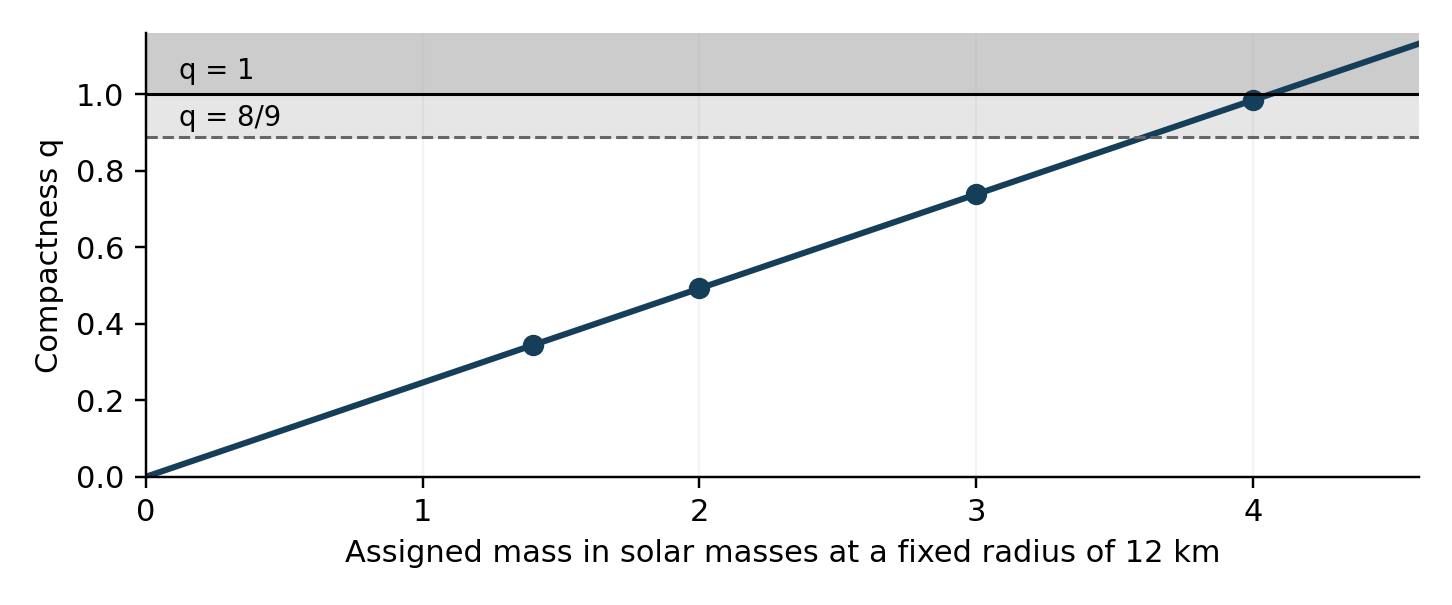
At R = 12 km, the surface-horizon equality q = 1 would occur at M = 4.06320 M☉. Buchdahl already demands M < 3.61173 M☉. Realistic equations of state can lose stability earlier. As an observational anchor, radio timing gives 2.08 ± 0.07 M☉ for PSR J0740+6620 at 68.3% credibility [4]; this is evidence that neutron stars can exceed two solar masses, not that four-solar-mass neutron stars are stable.
4 A pressure calculation that exposes the limit
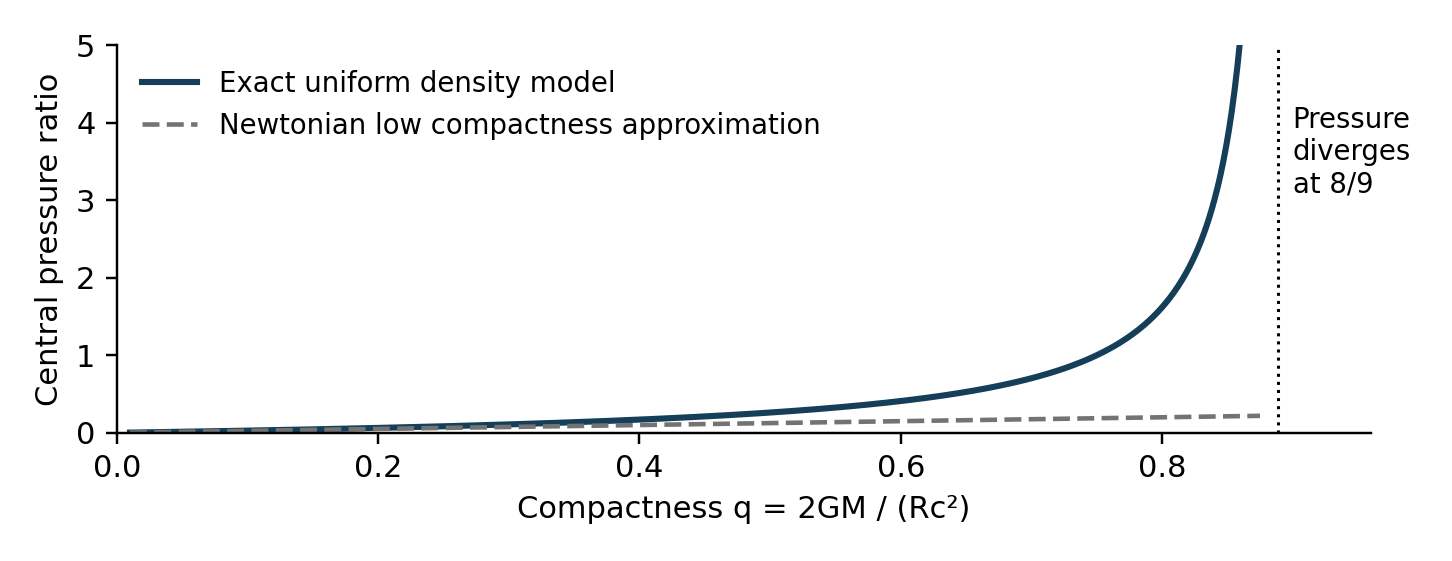
A uniform-energy-density fluid sphere has an exact relativistic interior solution. It is analytically useful but not a realistic neutron-star equation of state: strictly incompressible matter would have an unphysical infinite sound speed. We use it only to display the pressure cost of increasing compactness [2, 3].
Here pc is the pressure at the center, ρ is the constant mass-equivalent energy density, and q retains the definition in Equation 3. The expression applies to this specific equilibrium model for 0 ≤ q < 8/9. As q approaches 8/9 from below, its denominator approaches zero while its numerator stays positive, so the central pressure becomes unbounded.
For the 1.4 M☉, 12 km example, the uniform model has ρ = 3M/(4πR³) = 3.84605 × 10¹⁷ kg m⁻³ and pc/(ρc²) = 0.133264. Therefore pc = 4.606 × 10³³ Pa. At the same radius, assigned masses of 2.0 and 3.0 M☉ give pressure ratios 0.252617 and 0.913713. The formal 4.0 M☉ case lies outside the model’s physical domain; a negative algebraic continuation is not a physical solution.
What this does and does not prove
This example illustrates why “add enough neutron pressure” is not a route to an ordinary hydrostatic star inside its own Schwarzschild radius. The more general Buchdahl inequality supplies the result beyond the uniform model. Neither calculation proves a unique maximum mass for realistic neutron stars. That value depends on the equation of state, rotation, temperature, and stability. The early free-neutron-gas calculation of Oppenheimer and Volkoff is historically important, but its mass limit is not a modern universal limit [1].
5 What happens inside a trapped region
A second obstruction concerns causal motion rather than a specific pressure law. For radial motion in the vacuum Schwarzschild black-hole geometry, with angles held fixed, the interval is
The interval ds² describes spacetime separation; t is Schwarzschild time; r is areal radius. With the sign convention used here, a massive observer has ds² = −c²dτ² < 0, where τ is time measured by that observer’s clock. Inside the future black-hole region, 0 < r < rs, a path at fixed r would instead have ds² > 0. It is spacelike, so no physical observer can hover on it. All future-directed timelike paths in that Schwarzschild region proceed toward smaller r.
This argument is specifically about the Schwarzschild trapped interior. It must not be substituted for a solution in a matter-filled, time-dependent stellar interior, and it does not show that every point inside every evolving event horizon is already trapped. It does show why the familiar picture of a stationary neutron star sitting in the settled Schwarzschild interior is inconsistent.
A proper time illustration rather than a core lifetime
For a radial, freely falling test particle that started at rest at infinity, Schwarzschild geometry gives dr/dτ = −c√(rs/r). Integrating from the horizon to the classical r = 0 boundary yields
The symbol Δτ is elapsed proper time along that particular trajectory. It is not distant-observer coordinate time, a prediction of the lifetime of a neutron-star core, or a statement about the quantum endpoint of collapse. The calculation neglects the infaller’s self-gravity, pressure, spin, and the dynamical formation of the black hole.
| Black hole mass M/M☉ | Horizon radius km | Illustrative proper time horizon to classical boundary |
|---|---|---|
| 3 | 8.860 | 19.70 microseconds |
| 10 | 29.533 | 65.68 microseconds |
| 4 million | 11.813 million | 26.27 seconds |
| 1 billion | 2.953 billion | 1.824 hours |
Table 2. Equation 7 scales linearly with M. Larger black holes can offer longer infalling proper times; these numbers are model-dependent. Classical collapse and singularity results concern the failure of continued regular evolution under their assumptions, not an experimentally established material state at r = 0 [5, 6].
6 Why nuclear density does not identify a core
One apparent argument for the original hypothesis is that stellar-mass black holes can have a density comparable to neutron-star matter. The comparison is useful for scale, but it cannot identify interior composition. Define a purely nominal horizon density by dividing mass by the Euclidean volume formed from the areal horizon radius:
Here ρ̄H is an arithmetic diagnostic. It is not a measurement of local matter density, and 4πrs³/3 is not generally the invariant proper volume of a black-hole interior. The overbar and subscript H simply label this nominal average at the horizon radius.
| Mass M/M☉ | Nominal horizon density kg m⁻³ | Interpretation |
|---|---|---|
| 3 | 2.048 × 10¹⁸ | Above reference nuclear density |
| 10 | 1.843 × 10¹⁷ | Same rough density scale |
| 4 million | 1.152 × 10⁶ | Far below nuclear density |
| 1 billion | 18.43 | Low nominal average |
Table 3. The decrease as M⁻² shows that a large event horizon does not require a nuclear-density average throughout its enclosed coordinate volume. These values do not imply dilute material at the center.
Taking 2.8 × 10¹⁷ kg m⁻³ as an illustrative nuclear-density reference, Equation 8 matches it at M ≈ 8.11 M☉ and rs ≈ 23.96 km. That numerical coincidence gives no equation of state, equilibrium configuration, density profile, or stability criterion. It supports only the statement that a familiar density scale and a stellar-mass horizon scale can overlap.
A star is a configuration rather than an ingredient
Neutrons are ingredients; a neutron star is an organized, self-gravitating configuration. Collapsing matter can initially retain a neutron-rich composition while its radius and pressure distribution change rapidly. At still higher densities the relevant degrees of freedom may change, and a model based on identifiable free neutrons may fail. This study does not calculate such phase transitions.
An exterior gravitational mass also cannot be automatically assigned to a conjectured smaller central core. A black hole could form from a larger system containing a neutron star, surrounding gas, radiation, or other matter. Treating all of that mass as a 12 km neutron star would be a different hypothesis. The fixed-radius test in Section 3 concerns an isolated equilibrium configuration with the assigned mass, not every possible dynamical embedding.
7 The transient hypothesis that remains viable
Collapse of neutron star matter
If a neutron star becomes unstable, matter does not disappear at horizon formation. General-relativistic hydrodynamics follows the density, motion, and horizon formation during collapse. Simulations of unstable rotating neutron stars demonstrate precisely such dynamical evolution [7]. They do not demonstrate a permanent neutron star at a black-hole center.
Here tdyn is an order-of-magnitude dynamical time for the reference m★ = 1.4 M☉, R = 12 km star. It is about 0.0964 milliseconds. Numerical factors, relativity, thermal effects, and rotation change the detailed evolution. The value is neither a merger remnant’s guaranteed lifetime nor a time for all neutrons to change state. It supplies a useful scale for distinguishing hydrostatic support from rapid motion.
Capture by a much larger black hole
There is an especially clear weaker possibility: a neutron star can encounter the event horizon of a supermassive black hole before tidal forces destroy its gravitationally bound structure. A Newtonian order-of-magnitude tidal estimate compares the star’s self-gravity with the variation of the black hole’s gravity across it:
The symbol rt labels the approximate tidal disruption radius. For m★ = 1.4 M☉, R = 12 km, and MBH = 10⁶ M☉, it is rt ≈ 1.073 × 10³ km. The large hole’s Schwarzschild radius is 2.953 × 10⁶ km, giving rt/rs ≈ 3.63 × 10⁻⁴. Thus the horizon lies far outside the nominal tidal-disruption scale.
Equation 10 omits order-unity structure and orbit factors and is not a relativistic merger simulation. Extrapolating its tidal radius deep inside the horizon is not a precision prediction. Its useful conclusion is narrower: horizon crossing is not a material collision, and a large black hole need not exert destructive tides at that crossing. Relativistic work on extreme-mass-ratio neutron-star–black-hole mergers treats the merger of horizons and the star’s spacetime explicitly [8].
A defensible reformulation
Some black holes can contain neutron-rich matter, and may transiently enclose a neutron-star configuration during formation or capture. That material is dynamically evolving. It is not established as a long-lived ordinary neutron star at a stationary center.
The event horizon’s global definition is crucial: it can extend into an initially regular region before local trapping develops there. This allows transient inclusion without contradicting the trapped-region argument in Section 5. No universal survival duration follows without a specified spacetime and matter evolution.
8 Alternatives and observational tests
What a permanent core proposal would need to change
A regular black-hole model can replace a singular classical interior with different effective stress-energy. For example, Hayward’s nonsingular geometry uses a core with cosmological-constant-like behavior [9]. Such a core is not an ordinary neutron star with the conventional pressure-density relation. A mathematically regular metric is also not by itself evidence that realistic collapse produces a stable object.
Anisotropic stresses, strong rotation, modified gravity, or quantum effects can invalidate particular assumptions used here. That is a reason to solve a new model, not to label an excluded ordinary model viable. Rotating Kerr geometry differs from Schwarzschild and has a more complicated interior; its idealized inner horizon is vulnerable to mass-inflation instability [10]. This study does not claim that a spherical proof settles every rotating or exotic configuration.
A serious extension should specify the matter or effective stress-energy, solve the field equations with consistent boundaries, locate horizons and trapped surfaces, show regularity, and test dynamical stability. It must distinguish a true black hole from a horizonless compact alternative. Replacing a singularity with a stable neutron star cannot simply be asserted as a boundary condition.
What observations could establish
Radio timing, X-ray pulse modeling, and neutron-star mergers constrain dense matter outside black holes. The mass measurement in [4] is an example. Black-hole imaging and gravitational waves test the exterior gravitational field and the dynamics of formation and merger [11, 12]. Agreement with an exterior black-hole model does not directly identify the material inside an event horizon.
Classically, an event horizon prevents signals from its interior from reaching distant observers. A core wholly hidden behind a persistent horizon therefore cannot reveal its composition by ordinary outward light or sound. Indirect inference would need a specified model that changes a measurable process before horizon formation, changes the exterior, or changes the horizon itself.
For a horizonless alternative, a material surface could alter accretion emission, and a modified compact object could alter tidal response or late-time gravitational radiation. These are model-dependent tests. A deviation would not automatically establish a neutron-star core; environmental effects and alternative theories would need comparison. This paper calculates no echo waveform, luminosity, likelihood, or detection significance.
A testable next study
The most productive conventional extension is a relativistic hydrodynamic calculation of neutron-rich matter during collapse or extreme-mass-ratio capture. It should track proper time, density, temperature, composition, and trapped surfaces along matter trajectories. That would quantify the transient hypothesis without presuming a static endpoint. A permanent-core study would first need an explicit new physical model.
9 Limitations and conclusion
Limits of the evidence
The calculations are consistency checks, not a proof about all possible theories of gravity. The Buchdahl result applies to its particular matter and symmetry assumptions. The pressure curve comes from an incompressible diagnostic model. The time calculation uses one test-particle geodesic in Schwarzschild geometry. The tidal comparison is an order-of-magnitude estimate. None supplies the full interior of a rotating, accreting, quantum black hole.
No new equation of state has been fitted, and no numerical-relativity simulation has been performed. A radius of 12 km is an illustrative input rather than a data-derived posterior. The numerical precision shown makes the arithmetic reproducible; it should not be mistaken for comparable accuracy in the astrophysical assumptions. Observational citations anchor the physical context and are not presented as direct detections of interior neutron-star matter.
Classical singularity theorems establish geodesic incompleteness under stated hypotheses [6]. They do not experimentally determine an infinite-density object or its composition. Unknown high-curvature physics leaves the ultimate fate of collapsing matter unresolved, but uncertainty about that endpoint is not positive evidence for a conventional neutron star.
Conclusion
The stable-core hypothesis fails the standard equilibrium test used here. Ordinary neutron pressure does not provide a finite-pressure route to a static spherical neutron star inside its own Schwarzschild radius. The causal structure of the future-trapped Schwarzschild region also prevents an object from remaining at fixed areal radius. These are stronger constraints than a simple density comparison.
The transient-interior hypothesis remains physically reasonable. A newly forming horizon can enclose neutron-rich matter, and a sufficiently massive black hole can engulf a neutron star without destructive tides precisely at its outer horizon. Neither situation places an indefinitely supported ordinary neutron star at a settled central location.
The supported conclusion is therefore: some black holes can temporarily contain matter originating in neutron stars, but this study finds no standard-physics support for a long-lived ordinary neutron star at the center. Any permanent-core interpretation requires a different, explicitly specified model and independent evidence.
Reproducibility and provenance
All displayed numerical values follow from Equations 3–10 and the three constants in Section 3. The downloadable Python source uses only the standard library. Values were recomputed independently during preparation. The figures were generated from the displayed equations. The literature provides the physical frameworks; the numerical examples and wording here are an AI-assisted synthesis prepared for the reader.
Reproduce the calculations
The complete runnable Python appendix is included in the study PDF. Download the Python source and calculation results (JSON). The code verifies the algebraic numerical examples; it is not a stellar-structure integration or a numerical-relativity simulation.
References
Primary sources used for the theoretical framework and observational context. Reference numbers identify sources in the text; numerical examples are calculated in this study. Links lead to publisher records or author manuscripts.
[1] Oppenheimer, J. R., and Volkoff, G. M. (1939). On Massive Neutron Cores. Physical Review 55, 374–381. Source
[2] Tolman, R. C. (1939). Static Solutions of Einstein’s Field Equations for Spheres of Fluid. Physical Review 55, 364–373. Source
[3] Buchdahl, H. A. (1959). General Relativistic Fluid Spheres. Physical Review 116, 1027–1034. Source
[4] Fonseca, E., et al. (2021). Refined Mass and Geometric Measurements of the High-Mass PSR J0740+6620. Astrophysical Journal Letters 915, L12. Source
[5] Oppenheimer, J. R., and Snyder, H. (1939). On Continued Gravitational Contraction. Physical Review 56, 455–459. Source
[6] Penrose, R. (1965). Gravitational Collapse and Space-Time Singularities. Physical Review Letters 14, 57–59. Source
[7] Baiotti, L., et al. (2005). Three-dimensional relativistic simulations of rotating neutron-star collapse to a Kerr black hole. Physical Review D 71, 024035. Source
[8] Emparan, R., and Marín, D. (2020). Precursory collapse in neutron star–black hole mergers. Physical Review D 102, 024009. Source
[9] Hayward, S. A. (2006). Formation and Evaporation of Nonsingular Black Holes. Physical Review Letters 96, 031103. Source
[10] Poisson, E., and Israel, W. (1990). Internal structure of black holes. Physical Review D 41, 1796–1809. Source
[11] Event Horizon Telescope Collaboration (2019). First M87 Event Horizon Telescope Results. VI. The Shadow and Mass of the Central Black Hole. Astrophysical Journal Letters 875, L6. Source
[12] LIGO Scientific Collaboration and Virgo Collaboration (2016). Tests of general relativity with GW150914. Physical Review Letters 116, 221101. Source