Abstract
If gravity bends space, what happens after the bending? Why would no mark remain, and does something elastic restore the original shape? These questions expose a limitation of the familiar rubber-sheet picture. General relativity describes a dynamical spacetime geometry, not a demonstrated sheet of material. Its curvature has measurable effects, persists around enduring sources, and evolves when physical conditions change. It need not leave a permanent local dent, yet it can leave lasting physical records. Gravitational-wave memory is a particularly important predicted example: a passing wave can produce a persistent change in the relative separation of freely falling bodies even after its local radiative tidal effect has passed. This paper argues that the question about a footprint is productive, but the inference from bending to an elastic substance requires an additional premise and independent evidence.
The question in its strongest form
An ordinary bend usually has a bearer: a bent rod, a stretched membrane, or a compressed spring. Such objects resist deformation, and their later behavior depends on their structure. A reasonable challenge to the phrase “space bends” is therefore this: What physical property changes, how can the change be measured, and what determines whether it persists? A theory that supplies only a picture of a dent has not answered those questions.
The strongest version of the argument asks for a mechanism and an observable consequence. Its weaker version assumes that, because everyday bending involves material, gravitational curvature must involve the same kind of material. That assumption is exactly what needs examination. An analogy can motivate a hypothesis, but it cannot establish the hypothesis by itself.
The central distinction is between three different things: curvature that is present now, a field that changes with time, and a lasting record of an earlier interaction. General relativity gives different answers for each. Treating them as one “footprint” creates a puzzle that the physics does not require.
1 What bending means in general relativity
The word space is shorthand here. Einstein’s theory describes four-dimensional spacetime, which combines three spatial coordinates with time. Gravity affects spatial measurements, elapsed time, and the trajectories of matter and light. A picture showing only a curved spatial surface can conceal much of the explanation. [1]
The basic quantity is the metric, a field that specifies spacetime intervals between nearby events. One compact expression is
Here ds2 is the squared spacetime interval; gμν denotes the metric components; and dxμ and dxν are small coordinate differences. The Greek indices μ and ν run over four coordinates, and repeated indices mean a sum over them. A common convention takes the time coordinate to be x0 = ct, where c is the speed of light and t is coordinate time. In locally inertial coordinates, the interval’s time term has the opposite sign to its spatial terms.
Curvature is more specific than a metric that looks complicated. Even flat spacetime can acquire complicated metric components in unusual coordinates. Genuine curvature is encoded in the Riemann curvature tensor and has coordinate-independent physical consequences. One operational test compares nearby freely falling bodies: curvature can make their relative separation accelerate. These are tidal effects.
A concrete tidal example
In the weak gravitational field outside a spherical mass, two freely falling bodies separated radially by a small distance approximately obey
Here Δa is their relative radial acceleration, G is Newton’s gravitational constant, M is the source mass, r is their approximate distance from its center, and L is their radial separation, with L much smaller than r. The nearer body falls inward more strongly, tending to stretch the pair radially. This Newtonian-limit example illustrates what a local gravitational gradient does; the full relativistic description uses geodesic deviation. [1]
A rubber sheet can suggest that free paths depend on geometry, but it imports misleading details: a surrounding space, a downward force pulling the sheet, and a material tension that restores it. None is required by the mathematical definition of spacetime curvature. Curvature can be defined intrinsically through measurements within spacetime; it does not need a visible bend into an extra dimension. The diagram is an analogy, not the theory’s proposed substance.
2 What happens after the source changes
The question “what happens after space bends?” can suggest an event with a beginning and an end, like pressing a finger into foam. Many gravitational situations are instead approximately steady. The Sun continuously contributes to the solar system’s spacetime geometry. Its surroundings are not waiting to spring back while the Sun remains there.
Einstein’s field equation relates geometry to matter and energy:
The Einstein tensor Gμν is a particular combination of curvature. The cosmological constant Λ contributes to spacetime dynamics. The metric is gμν, and the stress-energy tensor Tμν describes local energy density, momentum, pressure, and stresses. The unindexed G is Newton’s constant, c is the speed of light, and π is the usual circle constant. The indices again label spacetime components. This is an equation for a dynamical field, not an elastic law for a substance. [1]
The equation does not mean that the material presently at one point uniquely fixes all curvature at that point. Initial conditions, boundary conditions, and the surrounding gravitational field also matter. Outside a star, local material stress-energy may be essentially zero while spacetime remains curved. In an ideal vacuum with Λ set to zero, the Ricci tensor vanishes, but the full Riemann tensor need not vanish. Gravitational waves can also travel through vacuum. “No matter here” therefore does not mean “no gravitational geometry here.”
There is no universal reset operation
If a source moves or changes, the geometry evolves according to the field equations and the relevant physical conditions. Changes do not inform distant observers instantaneously. Gravitational radiation propagates at the speed of light in general relativity. Suitable changes in a system’s mass distribution can emit waves, although not every motion does: perfectly spherical motion, for example, does not produce gravitational radiation in the usual isolated-system setting.
The later geometry may approach another nearly stationary state. It may retain curvature associated with a remaining star or black hole. A disturbance may travel outward, and some effects can persist as memory. There is no general rule that spacetime always becomes flat or always returns to its earlier state.
A thought experiment in which the Sun simply vanishes at one instant is not a complete physical process: one must specify what happens to its energy and momentum. A better experiment moves or transforms matter in a physically consistent way and then solves for the evolving gravitational field. Asking what restores the geometry before specifying that evolution assumes a spring-like process that the theory has not asserted.
3 Curvature already leaves observable evidence
A “trace” can mean evidence that gravity is acting, or a permanent remnant after a disturbance ends. These are different demands. General relativity has abundant evidence of the first kind. Several measurements connect its geometric predictions to observations; they do not require a permanent groove left behind by a passing object.
Light deflection and orbital motion
Light follows null geodesics, the locally straight paths appropriate to light in spacetime. The deflection of starlight near the Sun was measured in the 1919 eclipse observations, with substantial limitations by modern standards. Those results belong to the historical evidence, rather than serving alone as the modern case for the theory. Curved-spacetime light propagation also underlies gravitational lensing. The directly measured quantity is a change in apparent direction or image configuration, not a photograph of a material sheet. [2]
The orbit of the star S2 around the Galactic-center compact object supplies another example. The GRAVITY Collaboration reported a detection of Schwarzschild precession in 2020: the orbit’s orientation changes in the manner predicted by general relativity. This is evidence about the gravitational field inferred from repeated measurements of a star’s motion. It does not imply that the star carves a trail into space. [3]
Clocks and gravitational waves
Experiments have measured gravitational frequency shifts over laboratory height differences. These make the influence of gravity on clock comparisons concrete. Care is needed, however: a frequency shift alone is not a complete local curvature measurement. Accelerated observers can experience related clock effects even in flat spacetime. Tidal measurements and a consistent model are needed to distinguish the relevant physical situations. [4]
In GW150914, LIGO measured a transient signal consistent with gravitational waves from a binary black-hole merger. The observations supported the predicted propagation of dynamical spacetime disturbances and their effect on relative optical path lengths. The signal was not an imprint of a material dent passing through the instrument. It was a time-varying gravitational-wave strain inferred from calibrated detector data. [5]
A record need not be remaining curvature
An interaction can change an orbit, redirect a photon, transfer energy, or leave a record in a detector. The later universe then differs from a universe in which that interaction never happened. None of these records, by itself, implies that a patch of spacetime retains a permanent local curvature mark at the location where the interaction occurred.
Conversely, the absence of a visible scar is not evidence that no interaction took place. Physics does not require every real field disturbance to leave a permanent local field behind. The appropriate test is whether a specified observation agrees with a quantitative prediction. Gravitational-wave memory makes that point especially sharply because it predicts a lasting effect of a passing disturbance.
4 A predicted lasting trace called memory
A gravitational wave can contain an oscillatory component that alternately stretches and compresses transverse separations. General relativity also predicts displacement memory: after a burst, the relative separation of suitable freely falling test bodies can differ permanently from its earlier value. “Permanent” here describes the idealized before-and-after comparison, not an assertion that later forces can never change the bodies’ positions. [6, 7]
For initially comoving test bodies in the far zone of a weak, approximately plane wave, and with a suitable polarization and orientation, the leading relation is
Here L is the initial separation of the test bodies, ΔL is its lasting change, and Δh is the change in the dimensionless gravitational-wave strain between the early and late states. This simplified expression applies to an appropriately aligned transverse separation and a single polarization; general orientations introduce projection factors. It is not a universal formula for any pair of objects. Real interferometer mirrors are suspended and controlled; memory is sought through the signal and detector response, not a lasting lab displacement. [6]
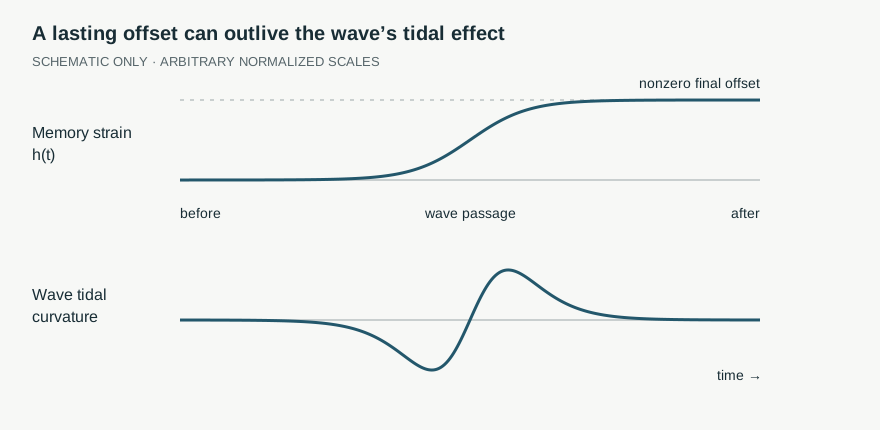
The important distinction is that a lasting displacement does not require a lasting local radiative curvature. Curvature during the wave changes the bodies’ relative motion and separation. Once that transient tidal influence has passed, a changed separation can remain. The relevant quantity is a measured before-and-after separation, not a coordinate offset alone. A continuing static gravitational field from a surviving source is a separate contribution and may still be present.
Ordinary memory can arise from changes in the motion of massive sources. Null memory is associated with energy carried away by radiation; the gravitational waves’ own energy produces the nonlinear contribution often called Christodoulou memory. Thus not all memory has the same source, and memory is not evidence for a rubber-like substrate. [6, 7]
5 What memory establishes and what it does not
Memory is a prediction with a clear observational meaning, but predicting an effect is different from detecting it. As of October 19, 2026, the primary analyses cited here do not establish a confident direct detection of gravitational-wave displacement memory. A 2026 hierarchical analysis of 258 binary-black-hole events found results compatible both with the general-relativistic memory amplitude and with no measured memory. This limitation concerns the small memory component, not the established detection of gravitational waves themselves. [8]
A complementary search in 15 years of NANOGrav pulsar-timing data also found no significant memory evidence. A nondetection at current sensitivity does not show that memory is impossible. The defensible conclusion is that general relativity allows a precise kind of lasting gravitational-wave trace, while measuring that trace remains difficult. [9]
Could spacetime be an elastic material
It is possible to propose that an underlying medium gives rise to the geometry we observe. The proposal is not ruled out merely because it uses unfamiliar language. But the footprint question does not establish that such a medium exists, and the word “elastic” is not yet a physical explanation. A scientific alternative or deeper model needs enough structure to calculate what happens.
First, define the substance and its state. What are the model’s measurable variables? What counts as an undeformed state? Does the medium define a preferred rest frame, and if so, how could observers detect it? If no preferred frame is observable, the model must explain how that result emerges.
Second, specify the dynamics. What equations determine deformation, propagation, energy, and interaction with matter? Ordinary elasticity needs material properties and a relation between stress and strain. An account of gravity must also explain why clocks and light behave as they do. Calling a parameter “stiffness” is insufficient unless it enters a testable equation.
Third, recover existing successful predictions. The model must match gravitational redshift, light deflection, orbital behavior, tidal effects, and gravitational-wave observations within their measured precision. It must also be consistent about energy and momentum. A picture that explains one intuition while failing these tests is not an improvement.
Fourth, state a distinguishing prediction. The most informative question is what the proposed medium predicts differently from general relativity: an additional wave polarization, a frequency-dependent wave speed, an observable preferred frame, or a specific extra memory effect, for example. These are possible test categories, not consequences already established for this proposal.
If a medium model exactly reproduces every prediction of general relativity in all accessible circumstances, current data may not distinguish the two descriptions. It could still be a useful interpretation or route to a deeper theory, but the observations would not uniquely confirm its material picture. A discovery requires more than a new metaphor.
6 Answering the original argument
Imagine two small freely falling probes, and compare two experiments. In the first, a massive body remains nearby. The probes experience the continuing tidal influence of its gravitational field. Asking why the curvature has not “healed” misses the continuing physical situation: the source and the field remain part of the system.
In the second, a gravitational-wave burst passes the probes. During its passage, their relative separation changes. Afterward, the wave’s local radiative curvature may become negligible. The separation may return approximately to its earlier value for a suitable purely oscillatory idealization, or it may retain a memory offset. Either outcome follows from the particular disturbance and initial conditions, rather than from a universal rule about space repairing itself.
This comparison answers the three questions directly. What happens after bending? The geometry and matter continue to evolve according to their equations. Why no footprint? The premise is too broad: gravity has observable effects, and some processes can leave lasting records, including predicted memory. Is an elastic material unbending itself? General relativity does not require that mechanism, and the question alone supplies no evidence for it.
The valid core of the argument is a demand for an operational explanation. That demand is satisfied by specifying what is measured, the dynamics that predict it, and the conditions under which a residual effect remains. The unsupported step is treating the mechanics of everyday materials as a necessary consequence of geometric language. Space and time may have a deeper microscopic description, but this question does not decide what that description must be.
Short glossary
Curvature. Intrinsic geometric structure measured through effects such as tidal relative acceleration; encoded fully by the Riemann tensor.
Geodesic. A locally straight path in spacetime. Ideal freely falling bodies and light follow the appropriate kinds of geodesics.
Metric. The field that determines spacetime intervals, clock readings, and local spatial measurements.
Strain. A dimensionless fractional deformation associated with a gravitational-wave signal; its measured effect depends on detector geometry.
Stress-energy. The mathematical description of matter and nongravitational energy, momentum, pressure, and stresses.
Tidal effect. A difference in gravitational acceleration between nearby freely falling bodies.
Vacuum. A region without local material stress-energy in the idealized theory; it need not have zero spacetime curvature.
Displacement memory. A lasting change in the relative separation of ideal test bodies after a gravitational-wave disturbance.
References and further reading
Numbered citations identify sources used in the argument. Links lead to original research, author-hosted scientific material, or research preprints. Reviews are identified explicitly. Publication status and memory evidence were checked on October 19, 2026.
[1] Tong, D. General Relativity. University of Cambridge lecture notes. Chapters 3-6 cover curvature, the field equations, waves, and black holes. Chapter 4; Chapter 5; Chapter 6. Chapter 3:
https://www.damtp.cam.ac.uk/user/tong/gr/grhtml/S3.html
[2] Dyson, F. W., Eddington, A. S., & Davidson, C. (1920). A determination of the deflection of light by the Sun’s gravitational field, from observations made at the total eclipse of May 29, 1919. Philosophical Transactions of the Royal Society of London, Series A, 220, 291-333. Original eclipse observations; open original scan.
https://doi.org/10.1098/rsta.1920.0009
[3] GRAVITY Collaboration. (2020). Detection of the Schwarzschild precession in the orbit of the star S2 near the Galactic centre massive black hole. Astronomy & Astrophysics, 636, L5. Original observational research.
https://arxiv.org/abs/2004.07187
[4] Bothwell, T., et al. (2022). Resolving the gravitational redshift across a millimetre-scale atomic sample. Nature, 602, 420-424. Original experimental research; NIST publication record.
https://www.nist.gov/publications/resolving-gravitational-redshift-across-millimetre-scale-atomic-sample
[5] Abbott, B. P., et al. (LIGO Scientific Collaboration and Virgo Collaboration). (2016). Observation of gravitational waves from a binary black hole merger. Physical Review Letters, 116, 061102. Original detection paper.
https://arxiv.org/abs/1602.03837
[6] Favata, M. (2010). The gravitational-wave memory effect. Classical and Quantum Gravity, 27, 084036. Review, including displacement memory and realistic detector response.
https://arxiv.org/abs/1003.3486
[7] Bieri, L., & Garfinkle, D. (2014). A perturbative and gauge invariant treatment of gravitational wave memory. Physical Review D, 89, 084039. Original theoretical research.
https://arxiv.org/abs/1312.6871
[8] Mitman, K., Isi, M., & Farr, W. M. (2026). Constraining gravitational wave memory with hierarchical inference. Physical Review D, 114, 064016. The 258-event analysis does not yield a confident memory measurement.
https://arxiv.org/abs/2605.27500
[9] Agazie, G., et al. (2025). The NANOGrav 15 yr Data Set: Search for Gravitational-wave Memory. The Astrophysical Journal, 987, 5. Original pulsar-timing memory search; no significant evidence reported.
https://arxiv.org/abs/2502.18599